 NeuralCapital
After Jensen Huang: Can NVIDIA's AI Empire Survive Its Founder?
Want to invest in NVDA?
Visit our How to Invest page to get started with platforms like Fidelity or Robinhood.
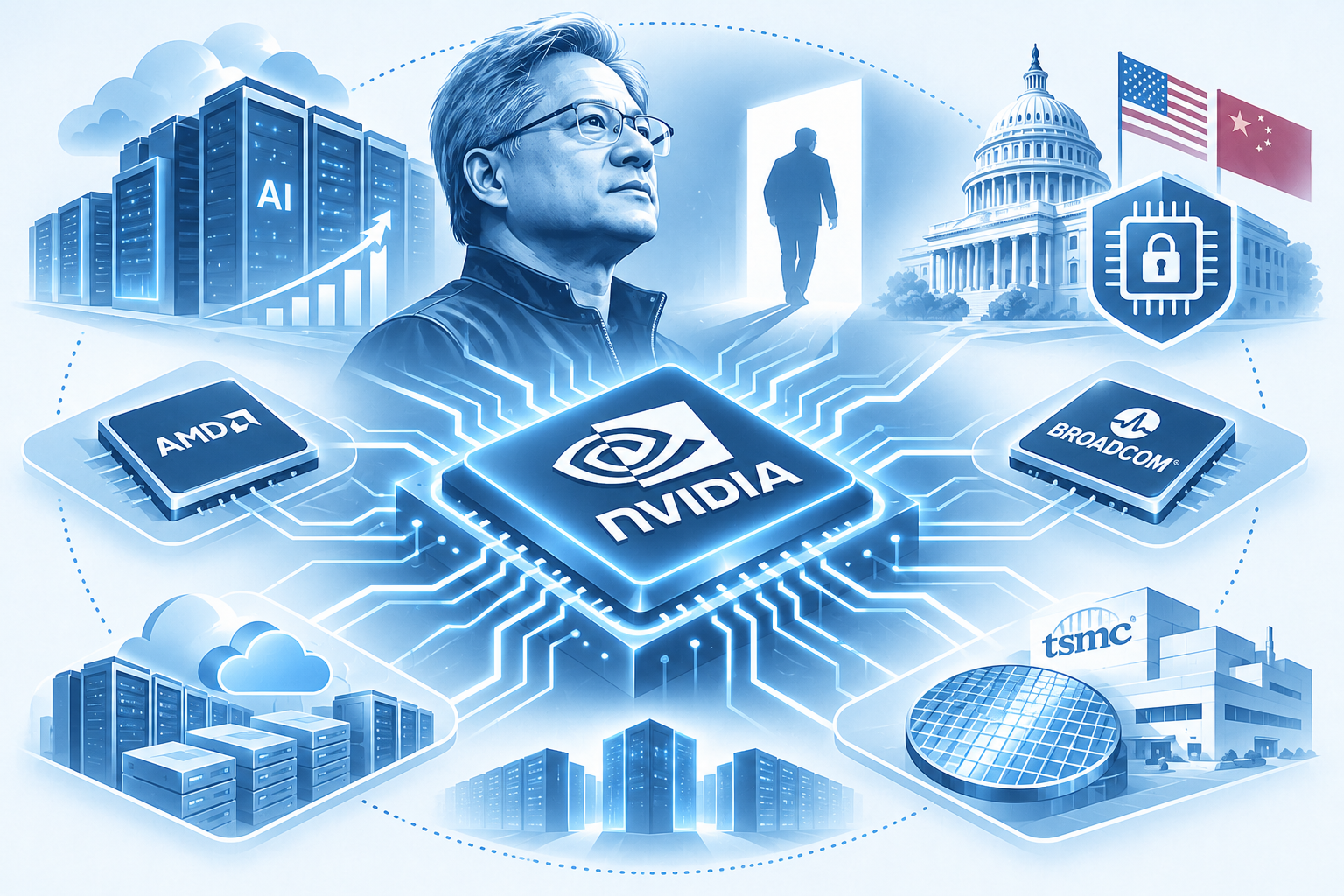
For more than three decades, Jensen Huang and NVIDIA were almost inseparable. The Taiwanese-born entrepreneur transformed a company known for graphics processors into the dominant supplier of computing technology behind the artificial intelligence revolution. His distinctive leadership, technological instincts and political relationships helped make NVIDIA one of the world's most valuable businesses.
That era has ended abruptly. On November 12, NVIDIA announced Huang's immediate resignation as president, chief executive and director, following a controversy involving personal relationships, allegations of Chinese espionage and mounting scrutiny of the company's governance. Chief financial officer Colette Kress has become interim chief executive, while longtime director Harvey Jones has been appointed board chair.
The allegations surrounding Huang remain the subject of investigations and public dispute. NVIDIA's board previously stated that it had no reason to believe company secrets or national security had been compromised, while acknowledging the need for an independent inquiry. The distinction between reported suspicions and established wrongdoing is essential, particularly when the consequences extend beyond a single executive.
For investors, however, the more enduring question concerns the company Huang leaves behind. NVIDIA's technology remains central to the AI economy, but its founder's departure exposes vulnerabilities that financial statements alone cannot measure. The crisis may become a test of whether NVIDIA's extraordinary competitive advantages belong to the institution or to the man who built it.
The Founder and the Franchise
NVIDIA's ascent was not inevitable. Founded in 1993, the company initially concentrated on graphics processors for personal computers and gaming. Huang recognized that the parallel-processing capabilities developed for graphics could eventually serve a much broader computing market.
The development of CUDA, NVIDIA's software platform for programming graphics processors, proved particularly consequential. By enabling developers to use GPUs for general-purpose computing, NVIDIA helped establish the technical foundations upon which modern AI systems would eventually depend.
The resulting advantage extends far beyond individual chips. NVIDIA supplies processors, networking equipment, software libraries, development tools and increasingly complete computing systems. Its technology is supported by an extensive ecosystem of developers, customers and infrastructure partners.
This makes NVIDIA difficult to displace. A competing chip may offer attractive performance or pricing, but customers must also consider software compatibility, engineering resources, deployment reliability and the costs of changing established systems.
Huang's role in creating this ecosystem was substantial. He maintained close relationships with major customers, helped coordinate product development across multiple technology generations and became one of the industry's most influential advocates for accelerated computing.
Yet a founder's importance can become a liability when an organization grows dependent on his judgment and relationships. NVIDIA now faces the challenge of preserving its technological and commercial momentum without the executive who shaped much of its strategy.
The company has not lost its engineers, intellectual property or installed customer base. But investors must determine whether the organization can maintain the same speed and coherence of execution under different leadership.
A Crisis That Extends Beyond Corporate Governance
The circumstances surrounding Huang's departure make this more complicated than an ordinary succession.
Reports concerning his relationship with a business executive associated with Singapore-based Megaspeed International have raised questions about possible foreign intelligence activity and the handling of sensitive semiconductor technology. U.S. intelligence authorities reportedly suspected the executive of connections to Chinese intelligence, while Megaspeed has faced scrutiny over the possible diversion of restricted AI chips.
These allegations do not establish that Huang knowingly assisted foreign intelligence or that NVIDIA's technology was compromised. China has denied the espionage accusations, and the relevant investigations have not produced publicly established conclusions sufficient to resolve the questions.
Nevertheless, the controversy has attracted congressional attention. Lawmakers have requested the preservation of government records concerning NVIDIA chip exports and reported intelligence warnings, reflecting growing concern about the intersection of commercial semiconductor sales and national security.
The implications are considerable because NVIDIA occupies an unusual position in the global economy. Its products are essential to commercial AI development, but advanced computing hardware also has potential military and intelligence applications. Decisions about where its chips can be sold increasingly involve governments as well as customers.
Huang was an influential advocate for maintaining access to international markets, including China. His departure could alter the company's relationship with Washington and complicate its efforts to balance commercial opportunities against national-security restrictions.
The risk is not necessarily that NVIDIA will immediately lose customers. It is that the company's strategic flexibility may narrow just as competition for advanced AI computing becomes more politically sensitive.
NVIDIA's Economic Defenses Remain Formidable
The most important distinction for investors is between a leadership crisis and deterioration in the underlying business.
NVIDIA's competitive position rests on capabilities accumulated over many years. Its hardware architecture, CUDA ecosystem, high-speed networking technology and relationships with major cloud providers create substantial barriers to competition.
The company's products are also embedded in enormous capital investment programs. Technology companies constructing AI data centers cannot simply replace their computing infrastructure overnight because NVIDIA has changed chief executives.
Customers must consider availability, performance, software support and the operational costs of alternative systems. In many cases, NVIDIA remains the most established option for deploying advanced AI workloads at scale.
This suggests that the immediate commercial consequences of Huang's departure may be more limited than the market reaction implies. Existing orders, development programs and customer relationships do not disappear with a change in leadership.
The longer-term risks are more difficult to quantify. NVIDIA's success depends on coordinating complex product releases, securing advanced manufacturing capacity and anticipating technological changes before competitors. Delays in execution or strategic disagreements could gradually weaken its advantages.
Leadership also matters in negotiations with customers whose spending commitments can reach tens of billions of dollars. Huang's personal credibility and relationships may have helped NVIDIA maintain its position as both supplier and strategic partner.
The company therefore enters its leadership transition with exceptional economic defenses, but also unusually high expectations. Its next management team must demonstrate that the organization can preserve its competitive strengths without relying on the founder's personal authority.
AMD and Broadcom: Opportunity Without an Automatic Victory
NVIDIA's difficulties inevitably raise questions about its competitors. Advanced Micro Devices and Broadcom are among the companies positioned to benefit if major AI customers accelerate efforts to diversify their computing infrastructure.
AMD has invested heavily in its Instinct accelerator family, seeking to offer alternatives to NVIDIA's dominant GPU platforms. Its opportunity is particularly relevant for large cloud providers that want greater bargaining power and additional sources of advanced computing capacity.
The challenge is that hardware performance represents only part of the purchasing decision. AMD must continue improving its software ecosystem, deployment capabilities and customer support while competing against NVIDIA's extensive installed base.
A leadership transition at NVIDIA could encourage some customers to examine alternatives more closely. It does not, however, eliminate the technological and commercial obstacles AMD faces.
Broadcom offers a different proposition. Rather than concentrating primarily on general-purpose AI accelerators, it has become an important partner for companies developing custom processors and the networking infrastructure required to connect large computing clusters.
Major technology companies increasingly want hardware tailored to their own workloads. Custom accelerators can potentially improve efficiency and reduce dependence on a single supplier, particularly when deployed at sufficient scale.
Broadcom could benefit if customers become more determined to diversify their AI hardware strategies. Yet custom-chip development requires substantial engineering investment and is not suitable for every workload or organization.
The broader lesson is that NVIDIA's leadership crisis may strengthen an existing trend toward supplier diversification. It does not mean competitors will suddenly inherit the company's market position.
The Manufacturing Reality Behind the Competition
Taiwan Semiconductor Manufacturing Company occupies a different position in this contest. As the world's leading advanced semiconductor foundry, TSMC manufactures sophisticated processors for NVIDIA, AMD and numerous other technology companies.
Its importance illustrates why the AI industry cannot be understood solely through the rivalry between chip designers. Advanced manufacturing capacity, packaging technology and production yields determine how quickly new processors can reach customers.
A shift in market share between NVIDIA and AMD would not necessarily reduce demand for TSMC's manufacturing services. Both companies depend heavily on the foundry's capabilities, making TSMC an important participant regardless of which designer captures the largest share of future AI spending.
This does not make TSMC immune to risk. Its operations are exposed to semiconductor cycles, capital-intensive manufacturing requirements and geopolitical tensions surrounding Taiwan.
Nevertheless, the company's position highlights an important distinction between competition within the AI industry and the infrastructure supporting that competition. Some businesses benefit from the overall expansion of computing demand even as individual technology leaders gain or lose market share.
For investors, the question is therefore broader than whether NVIDIA can defend its dominance. It is whether AI infrastructure spending continues expanding, and which companies can capture value as customers seek greater flexibility and resilience.
Washington May Become the More Difficult Customer
One of the least predictable consequences of Huang's departure concerns U.S. semiconductor policy.
NVIDIA has spent years navigating restrictions on exports of advanced chips to China. These rules reflect concerns that powerful computing systems could strengthen China's military and intelligence capabilities, even when the equipment is initially purchased for commercial purposes.
Huang argued that excessive restrictions could damage American technological leadership by encouraging Chinese customers to develop alternatives. That position placed NVIDIA at the center of a debate between economic competitiveness and national security.
The controversy surrounding his departure may strengthen the arguments of policymakers who favor tighter controls. Congressional scrutiny of NVIDIA's commercial relationships and the handling of intelligence warnings could make it politically more difficult to relax restrictions, regardless of the findings of the investigations.
For NVIDIA, the consequences could include additional compliance requirements, reduced access to certain customers and greater uncertainty surrounding international sales. The company must now navigate these questions without the executive who played such a prominent role in shaping its political relationships.
Competitors would not necessarily escape the effects. Broader restrictions on advanced computing technology could affect AMD and other American semiconductor suppliers, while encouraging China to accelerate investment in domestic alternatives.
The result may be a more fragmented global AI market. American companies could retain technological leadership while facing increasingly complicated restrictions on where their products can be sold and how customers can use them.
The Succession Problem
NVIDIA's immediate leadership arrangements provide continuity, but not yet a permanent answer.
Colette Kress has served as chief financial officer since 2013 and has helped oversee the company's extraordinary expansion. Her familiarity with NVIDIA's finances, customers and investment relationships should provide reassurance during the transition.
Yet leading NVIDIA requires more than financial discipline. The chief executive must coordinate engineering, manufacturing partnerships, software development and relationships with some of the world's largest technology companies.
The board's decision to consider both internal and external candidates reflects the importance of finding a leader capable of managing those competing demands. An internal appointment could preserve technological continuity, while an external candidate might introduce a different management structure and approach to governance.
The transition also raises questions about how much authority should be concentrated in a single executive. Huang's leadership helped NVIDIA move quickly and pursue long-term technological opportunities that competitors initially underestimated. But the absence of a clearly established successor illustrates the risks of allowing an organization's identity to become inseparable from its founder.
Investors should therefore watch more than the announcement of a permanent chief executive. The composition of the leadership team, the stability of senior engineering personnel and the company's ability to maintain its product roadmap will provide more meaningful evidence of institutional resilience.
What Investors Should Watch Next
The market's initial reaction has been severe, with NVIDIA shares falling sharply following the announcement. Such volatility reflects uncertainty about leadership, governance and the potential consequences of the investigations, rather than a sudden disappearance of demand for AI computing.
The distinction matters because share prices respond to expectations as well as operating performance. NVIDIA entered this crisis with a valuation reflecting confidence in continued growth, strong margins and technological leadership. Greater uncertainty can reduce the premium investors are willing to pay, even if the company's near-term financial results remain robust.
The coming quarters will provide several important tests. NVIDIA must demonstrate that its product development schedule remains intact, major customers continue placing orders and its relationships with manufacturing partners remain stable. Investors will also examine whether the company can preserve profitability while facing more determined competition.
For AMD and Broadcom, the relevant evidence will be customer commitments and actual revenue growth rather than speculation about market-share gains. TSMC's manufacturing activity may offer a broader indication of whether the AI investment cycle remains healthy.
The investigations and their regulatory consequences will require separate attention. Confirmed findings concerning corporate security or export compliance could have consequences beyond those associated with a conventional management transition. Conversely, a resolution that establishes no compromise of sensitive information could remove some uncertainty without resolving the broader questions about leadership and governance.
Above all, investors must distinguish between the future of NVIDIA and the future of artificial intelligence. The industry's expansion is driven by demand for computing, software and digital infrastructure, not by the career of any single executive.
An Empire Larger Than Its Founder
Jensen Huang's departure marks the end of an extraordinary chapter in the semiconductor industry. Few executives have influenced the direction of modern computing so profoundly, and fewer still have remained at the center of their companies through such dramatic technological change.
But the organization he built now faces a test that cannot be solved by another product launch. NVIDIA must prove that its competitive advantages are durable institutional assets rather than extensions of its founder's personal judgment, relationships and reputation.
The evidence offers reasons for both confidence and caution. NVIDIA possesses a formidable technological ecosystem, established customer relationships and a central position in AI infrastructure. Yet the company faces increasingly capable competitors, geopolitical constraints and a leadership transition occurring under exceptional scrutiny.
For AMD and Broadcom, the crisis may create opportunities to strengthen customer relationships and accelerate diversification. For TSMC, the broader demand for advanced semiconductor manufacturing may remain attractive regardless of which chip designer ultimately gains ground.
The deeper question is whether the AI economy has become sufficiently mature to withstand instability at its most influential supplier. NVIDIA's technology is embedded throughout the industry, but the growth of competing architectures and custom processors suggests that customers are already seeking a less concentrated future.
Huang helped build an empire around accelerated computing. His successors must now demonstrate that the empire can operate without him, while investors decide whether the extraordinary value created under his leadership can survive the uncertainty that follows.
Editorial Disclosure
Neural Capital receives no payment, sponsorship or compensation from NVIDIA, AMD, Broadcom, TSMC or any other company mentioned in this article. This publication is intended solely for independent editorial and informational purposes and does not constitute investment advice or a recommendation to buy or sell securities.
Readers should conduct their own due diligence, consult official financial disclosures and consider their individual investment objectives and financial circumstances before making investment decisions. Allegations and investigations discussed in this article should not be interpreted as findings of wrongdoing, and developments occurring after publication may materially change the circumstances described.
Want to invest in NVDA?
Visit our How to Invest page to get started with platforms like Fidelity or Robinhood.
Disclosure: This article is editorial and not sponsored by any companies mentioned. The views expressed in this article are those of the author and do not necessarily reflect the official policy or position of NeuralCapital.ai.