 NeuralCapital
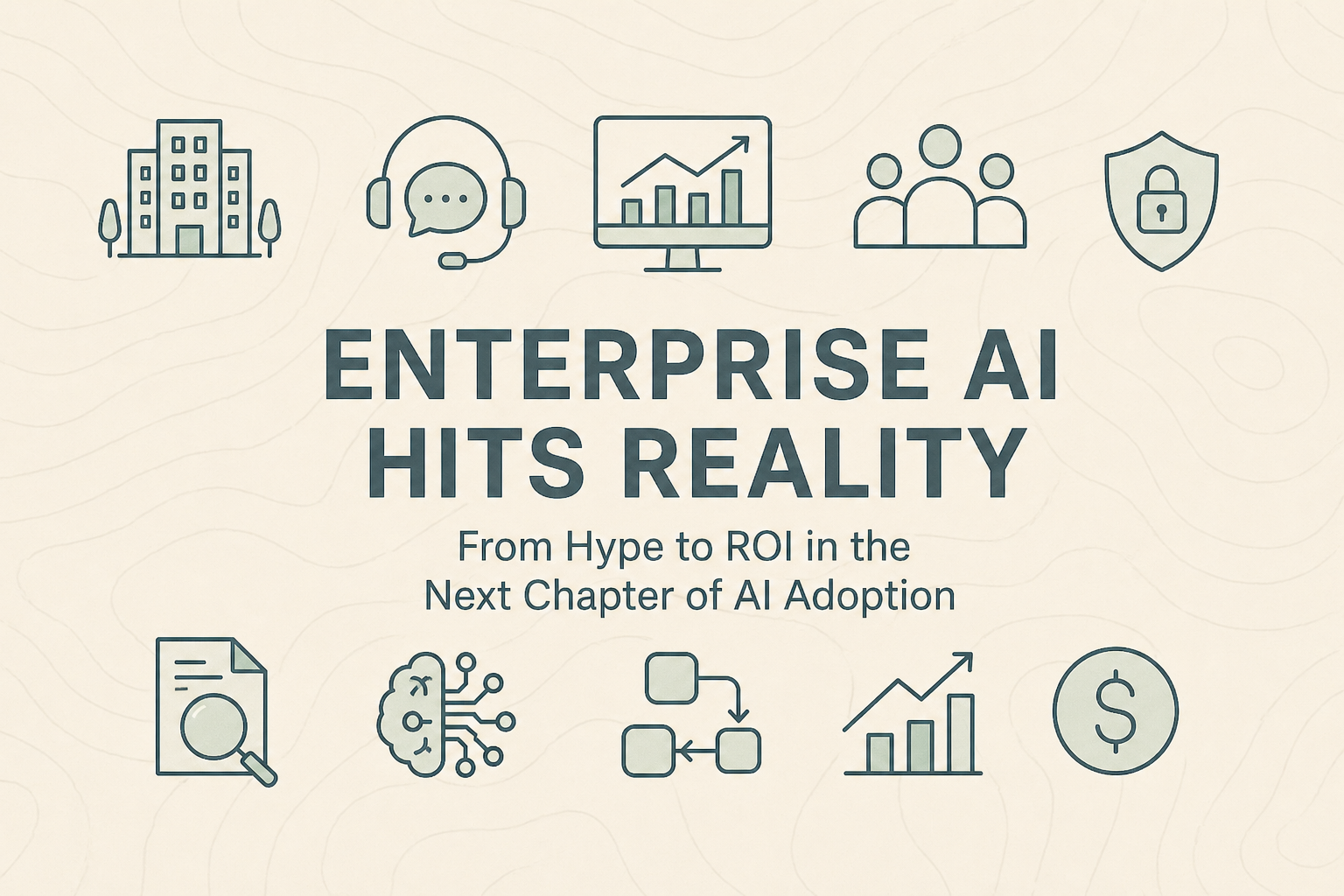
Enterprise AI Grows Up: The Reckoning Behind the Hype
Want to invest in MSFT?
Visit our How to Invest page to get started with platforms like Fidelity or Robinhood.
For a brief, intoxicating moment, artificial intelligence promised something close to magic. Companies rushed to sprinkle it across their operations—customer service, marketing, coding, strategy—hoping for transformation. Venture capital followed. So did exuberant valuations.
Now comes the sobering part.
Across corporate boardrooms, the conversation has shifted. The question is no longer whether to deploy AI, but whether those deployments are doing anything useful at all. For investors, this marks an inflection point: the transition from narrative-driven enthusiasm to earnings-driven scrutiny.
From Curiosity to Cost Centre
In the early wave, AI budgets were exploratory—small relative to overall IT spend, and often justified as strategic necessity. Today, they are being pulled into the same unforgiving light as any other investment.
Chief financial officers are asking awkward questions:
- Has productivity actually improved?
- Are costs falling—or merely shifting?
- Why hasn’t that pilot expanded?
This is not a philosophical shift. It is a financial one.
And it has consequences. Projects that cannot demonstrate measurable returns are quietly being shelved. Others are being re-scoped, narrowed, or absorbed into existing systems. The experimentation phase is ending; capital discipline is returning.
Where the Returns Are Real
The pattern emerging is neither random nor evenly distributed. AI is proving its worth in areas where work is repetitive, data-rich, and already digitised.
Customer support is a prime example. Here, AI systems can handle large volumes of predictable queries, reducing response times and limiting the need for additional hiring. Companies like Salesforce (CRM) are embedding AI deeply into service workflows, aiming to turn support from a cost centre into a more efficient, semi-automated function. The effect is not dramatic job displacement, but something subtler—and, from an investor’s perspective, more attractive: margin expansion through slower cost growth.
Software development offers another clear win. Tools from Microsoft (MSFT), via its ownership of GitHub, have increased programmer productivity, particularly in routine coding tasks. The implications are straightforward: if output rises without a commensurate increase in headcount, operating leverage improves. This is already feeding into the broader investment narrative around Microsoft’s AI monetisation strategy.
Sales teams, too, are benefiting—though less visibly. Platforms like HubSpot (HUBS) and Adobe (ADBE) are layering AI into marketing automation and customer engagement, enabling more personalised outreach at scale. The gains are incremental, but at scale they compound.
Even the humble act of finding information within a large organisation—long a source of quiet inefficiency—is being transformed. Enterprise search and knowledge tools from Alphabet (GOOGL) and Amazon (AMZN) are reducing the friction of internal knowledge, shaving minutes (and sometimes hours) off routine tasks. Individually trivial, collectively meaningful.
Where the Promise Falters
If some applications are thriving, others are struggling to justify their existence.
General-purpose chatbots, once heralded as a universal interface, have disappointed. Lacking deep integration into company systems, they often produce answers that are plausible but unusable. Employees revert to older tools; customers grow frustrated.
A similar fate is befalling a generation of startups—and, more subtly, the broader ecosystem surrounding foundation models. Even leaders like OpenAI (closely tied to MSFT) and Anthropic (backed by AMZN and Google) face pressure to prove that usage translates into durable, high-margin revenue streams.
Perhaps most telling are the projects that never progress beyond the pilot stage. These failures rarely stem from the models themselves. Instead, they reflect the messy realities of corporate infrastructure: fragmented data, incompatible systems, and unclear ownership. AI, it turns out, is not immune to organisational inertia.
The Hidden Constraint: Everything Around the AI
For all the attention lavished on model capabilities, the real bottleneck lies elsewhere.
Effective AI requires clean, accessible data; robust pipelines; and seamless integration into existing workflows. Many firms possess none of these. Their data is siloed, their systems outdated, their processes idiosyncratic.
This is where a different class of company stands to benefit. Firms like Snowflake (SNOW), Datadog (DDOG), and Palantir Technologies (PLTR) are positioning themselves as the connective tissue of enterprise AI—handling data integration, observability, and deployment at scale.
The result is a paradox. Demonstrations impress; deployments disappoint.
For investors, this suggests that the most valuable companies in the AI ecosystem may not be those building ever more powerful models, but those solving the unglamorous problems of integration, orchestration, and data management.
From Horizontal to Vertical
Another shift is becoming apparent. Broad, general-purpose tools are giving way to specialised, industry-specific applications.
In law, AI is being embedded into document review and contract analysis. In healthcare, into clinical documentation. In finance, into research and reporting. Incumbents and challengers alike—from Oracle (ORCL) in healthcare systems to Intuit (INTU) in financial workflows—are racing to embed AI into domain-specific products.
These systems succeed not because they are more intelligent, but because they are better aligned with the workflows they serve.
This has implications for market structure. Horizontal platforms may capture scale, but vertical solutions capture specificity—and often, pricing power.
What This Means for Investors
The easy phase of the AI trade—the one driven by excitement and multiple expansion—may be behind us. What comes next is more demanding.
Investors will need to distinguish between:
- Adoption and impact (deployment does not guarantee returns)
- Revenue growth and margin improvement (AI that sells well is not always AI that saves money)
- Sustainable advantage and temporary novelty
Companies like NVIDIA (NVDA) have benefited enormously from the infrastructure build-out phase. The next question is whether downstream enterprise adoption sustains that demand—or moderates it.
Meanwhile, platform companies such as Microsoft (MSFT), Alphabet (GOOGL), and Amazon (AMZN) are betting that tight integration across their ecosystems will translate into durable enterprise spending.
The winners will be those that can turn AI into repeatable, measurable economic value—not just technological capability.
A More Subtle Transformation
If this sounds underwhelming, it should not.
The most profound technologies often integrate quietly, improving processes rather than overturning them. Electricity did not transform factories overnight; it took decades of reconfiguration. AI may follow a similar path.
For now, the signal is clear. The market is beginning to reward substance over story.
And in that environment, only one question matters:
Does it pay?
Want to invest in MSFT?
Visit our How to Invest page to get started with platforms like Fidelity or Robinhood.
Disclosure: This article is editorial and not sponsored by any companies mentioned. The views expressed in this article are those of the author and do not necessarily reflect the official policy or position of NeuralCapital.ai.